Philippines / Mindanao
Lokot-Lokot
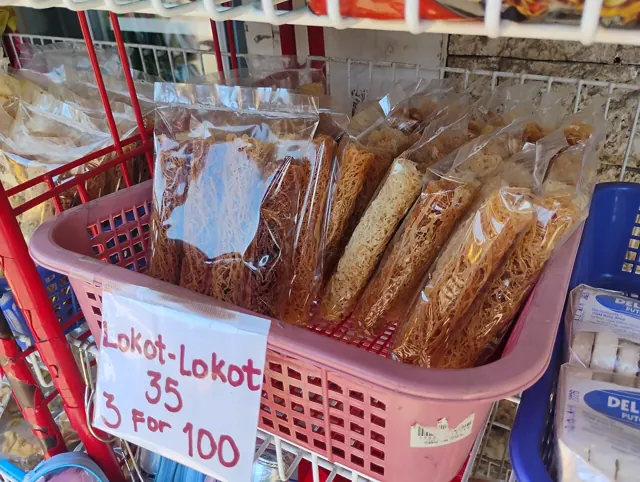
crispy fried glutinous rice coils
A fried rice sweet with a crisp lattice of fine strands, associated with Mindanao and Sulu.
APPROXIMATE ENERGY
180–280 kcal
3-4 coils
How to read this estimate
Indicative range from the original catalog, awaiting nutritional validation. Recipe and serving size can substantially change the result.
Our visual scale per serving: low, under 400 kcal; medium, 400–700; high, over 700. The colour uses the midpoint of the range; it is not an official label or a health rating.
A DISH, A PLACE
What it is. What it tells you.
Its appearance comes from the tool: batter falls through holes in a coconut shell into the oil, forming a lattice. It is folded or rolled while still pliable. The brittle texture distinguishes it from dense, sticky dodol. Local names vary; in Sulu it is also known as jaa.
Make it part of your trip.
When to try it
It is documented at celebrations such as Eid al-Fitr; that cultural connection does not guarantee availability on any given date.
Where to look
Mindanao and the Sulu archipelago. The photograph on this page is identified by its author as lokot-lokot from Zamboanga.
How it is made.
A preparation overview from the catalog. This is not a recipe tested in our kitchen.
- Mix the flour with water into a thick batter that falls in threads.
- Pipe the batter through the uluyan into 180 °C oil, drawing spirals.
- Fry 1-2 min until golden and lift out the whole mat.
- Roll it while still hot with two wooden spoons.
- Drain and serve at weddings and feasts, or with coffee.
Sources and scope.
Documentary check: 2026-11-08. The references below were consulted; this does not establish a personal visit or a kitchen test.
- Wikipedia · Lokot-lokot — Names, tools and festive context.
- Wikipedia · Lokot-lokot